Cultural Literacy
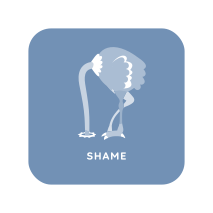
The Shame card from MethodKit for Cultural Literacy
Card 27 of 62 · MethodKit for Cultural Literacy
  • ThemeBoundaries & the unspoken
  • Card27 of 62
  • Questions5 to explore
Boundaries & the unspoken

Shame

Things that are seen as shameful

Shame is one of the most powerful regulators of social behaviour, and its targets vary so much across cultures that what destroys a reputation in one place barely registers in another.

Every culture uses shame to protect what it values most: family honour, individual dignity, group loyalty, religious purity, professional competence, or something else. The trigger differs, but the mechanism is similar: a sense that you have fallen short of what your community expects, and that others know it. Understanding what carries shame in a given culture is a fast route to understanding that culture's deepest priorities.

Shame operates at different scales. Some cultures orient more around an individual's own sense of having failed their values (sometimes called guilt-based systems), while others place more weight on how the community perceives and responds to the failure (sometimes called shame-based systems). This is a rough and much-debated distinction, but it is useful for noticing that the same act can trigger very different consequences depending on whether the damage is primarily internal or primarily social.

How it varies across cultures

The same facet, lived differently. These are tendencies and illustrations, not rules, and never a ranking.

Family and collective shame

In many East Asian, South Asian, and Middle Eastern cultural contexts, one person's conduct reflects directly on their family or community. Shame is collective, and the pressure to avoid bringing shame on others is a strong motivator.

Individual dignity and failure

In many Western European and North American settings, shame tends to attach more to individual failure: bankruptcy, perceived incompetence, or moral hypocrisy. The family is less implicated, but the individual's self-image is heavily at stake.

Sexual and bodily shame

What is shameful about bodies, desire, and sexuality differs enormously: across religious traditions, rural versus urban contexts, and historical periods. These are often the most charged and the least visible norms to outside observers.

Questions to explore

Use these on your own or in a group. There are no right answers, only better conversations.

  1. What kinds of failure or behaviour carry the most shame in a culture you know well, and what does that tell you about its values?

  2. How does shame function differently when it is privately felt versus publicly assigned by others?

  3. When you think about shame across generations in your own background, how have the triggers shifted?

  4. How does a person navigate situations where the shame norms of their home culture conflict with those of the culture they live in now?

  5. What is the difference between healthy accountability and shame that becomes a tool of control or exclusion?

Things to notice

  • Shame can look like silence, deflection, or over-explanation. What reads as evasiveness from one cultural angle may be an attempt to preserve dignity from another.
  • The absence of visible shame does not mean a behaviour is accepted. In many contexts, shame is managed privately and performed composure covers genuine distress.
  • Be careful with frameworks like 'shame culture versus guilt culture'. They are a starting point, not a label to apply to whole nations or peoples.